A Precision Model for Colorectal Cancer Screening Adherence: Integrating Predictive Analytics and Adaptive Intervention Strategies
Keywords:
Colorectal cancer, hypergraph neural networks, multi-modal deep survival analysis, precision intervention, predictive analytics, reinforcement learning, screening adherenceAbstract
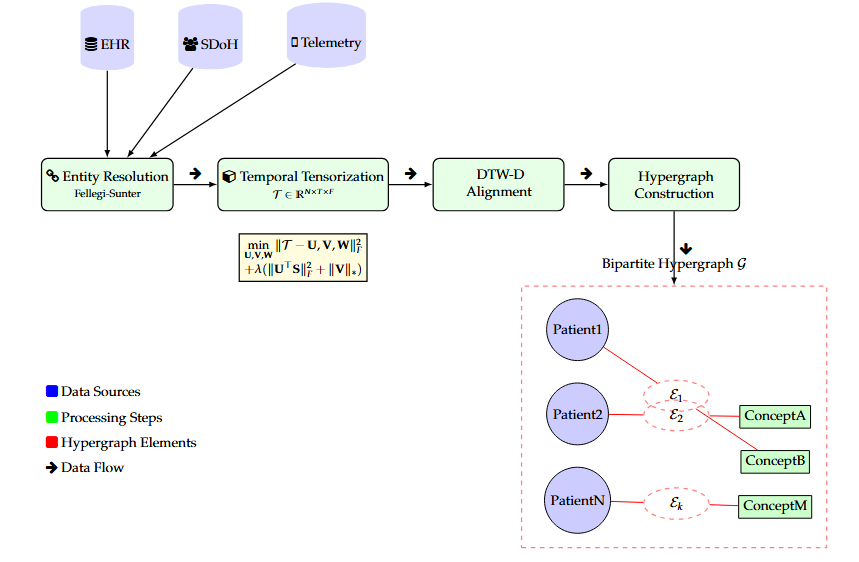
Colorectal cancer (CRC) remains a leading cause of cancer death despite consistent low adherence rates to screening compared to clinical guidelines. The article presents a novel conceptual model that integrates predictive analytics and precision intervention strategies for optimizing CRC screening adherence in three aspects. (a). As an initial step, the framework incorporates heterogeneous multi-source data - including high-dimensional electronic health records (EHRs), social determinants of health (SDoH) indices, and behavioral telemetry from mobile health platforms - into a unified graph-based knowledge representation via hypergraph neural networks. (b) Second, a temporal convolution attention-augmented multi-modal deep survival analysis model predicts time-varying nonadherence risks, explicitly handling both static covariates (e.g., genetic predispositions) and dynamic temporal trends (e.g., care access frequency decay curves). (c) Third, the intervention engine employs constrained reinforcement learning (CRL) with counterfactual fairness constraints to assign personalized nudges (e.g., automated reminders, navigator support) dynamically subject to time-varying resource constraints. A closed-loop feedback system enables model updating via adversarial validation against real-world data stream drifts with Wasserstein distance minimization. Theoretical contributions include (1) a topological embedding space using persistent homology for care pathway deviation modeling, (2) a non-Markovian decision process with provable approximation guarantees for longitudinal adherence optimization, and (3) an information-theoretic argument for minimal sufficient interventions based on rate-distortion theory. This system attempts to bridge computational epidemiology and health operations research to advance precision prevention paradigms.